
Stop Trading From Memory.
Build a Process You Can Review.
From Chaos to Consistency is a practical 116-page guide that connects market structure, strategies, risk management, execution, psychology and journaling—so you can turn scattered knowledge into clearer rules and decisions you can review.
- Define your risk, invalidation and exit before the trade
- Connect setups and confluences instead of collecting random indicators
- Track your decisions, results and recurring mistakes with the included journal
One-time payment · Instant digital access · Educational material only
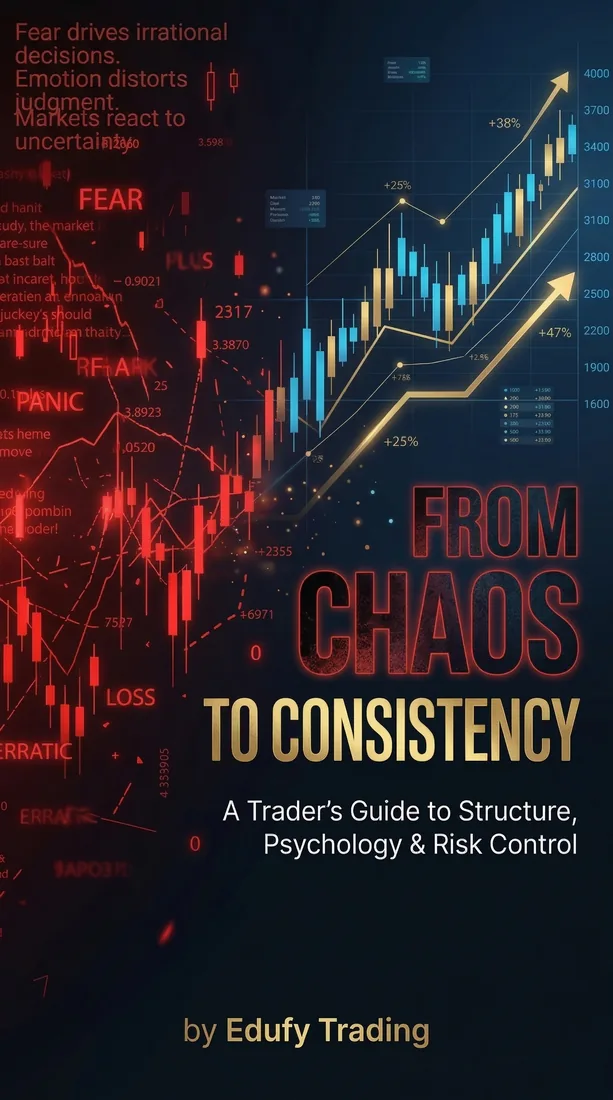
116-page
guide + journal
116
Pages of structured guidance
7
Core modules
Trading journal
Included digital template
$29
One-time payment
SOUND FAMILIAR?
You know the setup.
Then the trade opens—and the rules start changing.
A strategy can look clear before entry. Once money and emotion are involved, risk gets adjusted, entries get rushed, stops move and the original plan becomes harder to follow.
Risk changes from one trade to the next
A small position after one loss becomes a larger position after the next. Without fixed risk rules, every trade becomes a new decision.
You enter before the setup is complete
You know what confirmation should look like, but impatience or FOMO pulls you into the market before your conditions are fully met.
Stops and targets change mid-trade
The plan made before entry is replaced by hope, fear or greed once price starts moving.
The same mistakes keep repeating
When trades stay in your memory instead of a journal, it is difficult to see which setups, decisions and behaviours are actually repeating.
Breaking a rule is not always a failure of willpower. Sometimes the rule was never made clear enough to follow.
THE REAL GAP
More information does not automatically create better decisions.
Trading concepts are easy to collect separately: a candlestick pattern here, an indicator there, a risk rule somewhere else.
The harder part is connecting analysis, risk, execution and review into one written process—before a position is open and emotions are involved.
Consistency in process—not guaranteed trading results.
Scattered knowledge
- Indicators
- Setups
- Risk ideas
- Emotional reactions
- Trades kept in memory
A reviewable process
- Clear conditions
- Defined risk
- Planned execution
- Documented decisions
- Structured review
THE PROCESS
Connect the four parts that are usually learned separately.
A strategy is only one part of trading. The guide helps you connect what you analyse, how you control risk, how you execute and how you review the result.
Know what you are looking for
Identify the market condition, important levels, setup, confirmations and the point that invalidates the idea.
- Market condition
- Key levels
- Setup
- Confirmation
- Invalidation
Define the downside before entering
Plan position size, risk per trade, stop placement, risk-to-reward and leverage before the outcome can influence your judgement.
- Position sizing
- Risk per trade
- Stop placement
- RR
- Leverage
Make fewer decisions under emotion
Prepare the trade while you are calm, then use written rules to guide the decisions that become harder once money is at risk.
- Entry conditions
- Exit plan
- Trade management
- Rule adherence
- Emotional control
Turn every trade into usable information
Record the reason for entry, risk, result, observations and mistakes so you can compare decisions across a meaningful series of trades.
- Trade journal
- Setup review
- Mistake tracking
- Weekly analysis
- Process improvement
INSIDE THE GUIDE
A compact reference for analysis, risk, execution and review.
The book brings together the technical and behavioural parts of trading in one structured guide. It is not a signal service or a shortcut—it is a framework you can study, apply and review.
Trading Foundations & Market Structure
Build the context needed to read market conditions and understand how price moves across different timeframes.
- Technical vs. fundamental analysis
- Market cycles and conditions
- HTF vs. LTF analysis
- Market participants and trader types
- The role of futures markets
Candlesticks & Price Action
Learn how candles, levels, trends and chart structures can provide context before a trade.
- Bullish and bearish candlesticks
- Doji, hammer and shooting star
- Support and resistance
- Trends, ranges and trendlines
- Major chart patterns
Indicators & Market Context
Understand what common indicators measure and how they can be used as supporting information rather than isolated signals.
- RSI and Stochastic RSI
- Moving averages
- Volume and MACD
- Bollinger Bands
- Divergences
Fibonacci & Key Levels
Use retracement levels together with price structure and support or resistance.
- Fibonacci retracements
- The golden pocket
- Support and resistance confluence
- Fibonacci in trending markets
Strategies & Confluences
Study practical setup structures and learn how multiple pieces of information can support or invalidate a trading idea.
- Flip-retest setups
- Double and triple reversals
- Wedges and head-and-shoulders
- Price and moving-average crosses
- Price action, candles and indicator confluence
- What to review when a setup fails
Risk Management & Position Sizing
Learn how to structure risk before entering a position instead of making risk decisions while the trade is already open.
- Confirmations and invalidations
- Stop-loss placement
- Position sizing
- Risk per trade
- Breakeven and partial profits
- Risk-to-reward and evolving R
- Leverage in crypto, forex and indices
Trading Plan, Journal & Psychology
Connect written rules, trade documentation and emotional awareness into a process that can be reviewed over time.
- Building a detailed trading plan
- Planning the trade before entry
- Trading journal structure
- Tracking results and recurring mistakes
- Revenge trading and overtrading
- Fear, impatience, greed and ego
- Discipline and emotional management
INCLUDED TRADING JOURNAL
Your memory can't show you which mistakes keep repeating.
Your journal can.
The included journal gives you one place to record the logic and outcome of each trade—not just whether it finished in profit or loss.
Track the reason for entry, direction, risk, RR, outcome, observations and mistakes. Then use weekly and monthly views to review patterns instead of treating every trade as an isolated event.
The journal is delivered as a ready-to-duplicate Notion template and includes a setup tutorial.
- Record the reason behind every entry
- Track risk, RR, outcome and observations
- Compare setups across multiple trades
- Identify recurring execution mistakes
- Review weekly and monthly patterns
- Use dedicated structures for crypto, forex and stocks
IS THIS FOR YOU?
Designed for traders who know the concepts but need a clearer process.
This guide is for you if:
- You already understand basic trading terminology
- You know common setups but do not always follow your rules
- Your risk changes from one trade to another
- You sometimes enter early, move stops or hold too long
- You consume a lot of trading content but struggle to organise it
- You rarely review your trades systematically
- You want a written process for analysis, risk, execution and review
This guide is not:
- A signal service
- A guaranteed trading system
- Personalised financial advice
- A promise of profit or income
- A shortcut to becoming a professional trader
- A replacement for practice and independent judgement
- An advanced quantitative or institutional trading programme
Beginners can use the foundational chapters and glossary, but the guide is primarily written for traders who already know the basic language of the markets.
WHY EDUFY TRADING CREATED IT
Built to organise the parts traders usually learn separately.
Trading education is full of isolated concepts—a candlestick pattern here, an indicator there and a risk rule somewhere else.
From Chaos to Consistency was created to bring those pieces into one compact reference and connect technical analysis with risk management, planning, journaling and psychology.
The guide draws on practical experience across crypto and forex, while explaining concepts that can also be used when studying stocks, indices and futures.
It is published as educational material. It does not provide signals, personalised recommendations or guaranteed outcomes.
ONE PRODUCT · ONE-TIME PAYMENT
Get the complete guide and trading journal for $29.
No subscription and no signal service. One purchase gives you the complete ebook, the journal and the instructions needed to start using it.
- Complete 116-page PDF ebook
- All 7 structured modules
- Annotated chart and setup examples
- Risk management and position-sizing guidance
- Trading plan and psychology sections
- Ready-to-use Notion trading journal
- Journal setup tutorial
- Instant digital delivery
Educational product · No subscription · No signals · No guaranteed results
This is an instant-access digital product, so all sales are final. See our Terms & Conditions.
FAQ
Questions? Answered.
It is primarily designed for self-directed traders who already understand basic trading terminology and common chart concepts but need a clearer process for analysis, risk, execution and review.
The guide includes foundational explanations, trading terminology and introductory technical-analysis concepts. However, its strongest fit is for readers who already know the basics and want to organise that knowledge into a clearer process.
You receive the complete 116-page PDF ebook, access to the ready-to-use Notion trading journal and a tutorial explaining how to duplicate, configure and use the journal.
The guide contains concepts and examples relevant to crypto, forex, stocks, indices and futures. Principles such as planning, risk management and review can be applied across markets, but position sizing, leverage, volatility and execution conditions can differ. The guide explains several of these distinctions.
You can record the pair or market, date and time, reason for entry, session, direction, risk, RR, outcome, profit or loss, observations and mistakes. The journal also includes weekly and monthly views for reviewing patterns.
No. It does not tell you what asset to buy or sell and does not provide personalised trade recommendations. Its purpose is to help you study and organise your own decision-making process.
No specific result can be guaranteed. The guide is designed to help make your process more structured, documented and reviewable. Trading outcomes depend on many factors, including your decisions, experience, risk, market conditions and application of the material.
After payment, you receive instant access to the ebook and the journal instructions by email, with a secure download link for the PDF.
The ebook is delivered as a PDF. The included journal is provided as a Notion template, which you can duplicate into your own Notion workspace. The setup tutorial explains the process.
Yes. Trading and leveraged products can involve substantial risk, including the loss of capital. This product is educational and does not remove or reduce the risks inherent in financial markets.
Because the ebook is an instant-access digital product, all sales are final and we don't offer refunds once you've received access. Full details are in our Terms & Conditions.
Stop leaving important decisions until after the trade is open.
Build a clearer process for analysis, risk, execution and review—with the complete guide and trading journal in one purchase.
One-time payment · Instant digital access · Educational material only